
Exploring geometry, vibration, resonance, and the relationships through which life expresses itself
Geometry determines relationships, boundaries, pathways, and possibilities for interaction. I have linked this web page on Key Cell Types and Tissues in the Human Body, to help remember the variety of geometric shapes of cells in our body. A reminder of the intricate and complex system we are. It is mind-blowing to think of how our bodies, everyday, create new cells for all the organs and processes that make life possible.
When we approach geometry not simply as a shape, but as an organizing principle through which energy, matter, and living systems interact, it opens our perspectives.
Imagine a river.
The water doesn't need instructions specifying precisely how to flow around each stone.
Its movement emerges through the relationship between gravity, pressure, momentum, the riverbed, and its surrounding boundaries.
Change the shape of the riverbed, and the flow can change.
You haven't instructed each molecule where to go.
You've changed the conditions within which the water organizes its movement.
What if geometry is not merely the form that matter takes, but one of the ways matter receives, organizes, and responds to information?
This takes us into mechanobiology, morphogenesis, acoustic physics, cellular memory, and the relationship between vibration and structure.
Geometry and Cellular Transformation
1. The Star, the Flower, and Cellular Transformation
In 2010, researchers led by Kristopher Kilian published Geometric Cues for Directing the Differentiation of Mesenchymal Stem Cells.
They placed human bone-marrow-derived stem cells onto microscopic adhesive patterns with different geometries.
The results were fascinating.
Star-shaped patterns, with sharp points and inward-curving boundaries, favored differentiation toward bone-forming osteoblasts.
Flower-shaped patterns, with rounded outward-curving boundaries, favored differentiation toward fat-storing adipocytes.
The critical distinction is that they weren't simply exposing cells to symbolic images. They were physically controlling the geometry available for the cells to occupy.
Both groups received the same chemical conditions, but their mechanical environments differed.
The geometry affected the organization of the cell's internal structural network, particularly actin filaments and the forces generated by the cytoskeleton.
So a change in external geometry became a change in internal mechanical organization, which affected gene expression and cellular development.
It's about geometry participating in determining which biological possibility becomes expressed.
2. The Geometry Reaches All the Way into the Nucleus
A particularly interesting development came in 2024.
Researchers investigating mesenchymal stem cells found that the curvature of the cell nucleus itself was closely associated with the activity of YAP, a protein involved in translating mechanical conditions into cellular responses.
External forces can influence the cytoskeleton, which can change nuclear shape and affect the organization and activity of genetic material.
A form arises from previous conditions, but that form then influences which subsequent conditions become possible.
Not a repetition of the same event, but a process of successive transformation.
The cell is not merely receiving information. Through its response, it is participating in constructing the conditions of its next experience.
3. The Icosahedron and Virus Neutralization
In 2021, scientists published Programmable Icosahedral Shell System for Virus Trapping.
They used DNA origami, which involves folding DNA into precisely engineered nanoscale structures, to construct shells based on icosahedral geometry.
An icosahedron has 20 triangular faces. Many viruses naturally have protein shells organized with icosahedral symmetry.
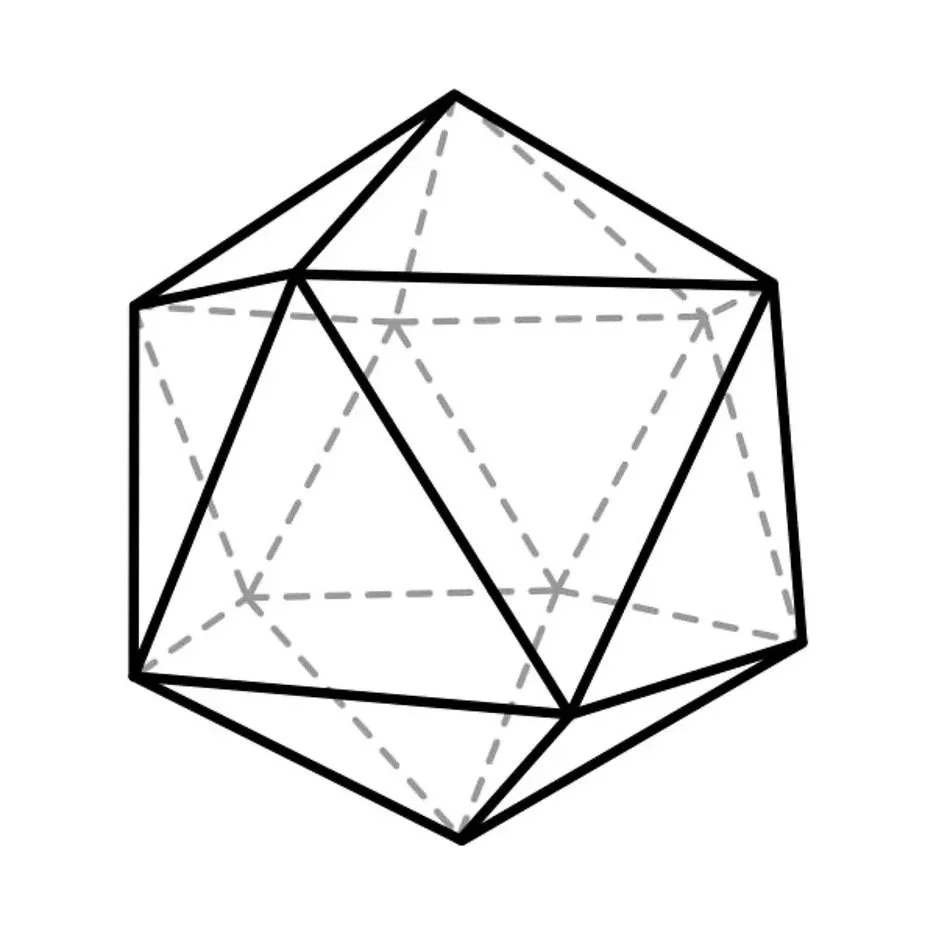
Researchers engineered nanoscale shells that could capture viral particles and physically prevent certain interactions necessary for infection.
The shells contained molecular binding sites, including antibodies, that helped attach them to the targeted viral particles.
The researchers demonstrated that these engineered structures could inhibit hepatitis B virus core-particle interactions and neutralize adeno-associated virus infection in cultured human cells.
The engineered structure physically constrained the ability of the targeted viral particles to interact with surrounding cells.
Consider the relationship between these discoveries:
In the stem-cell experiment, geometry influences the possibilities of cellular development.
In the virus experiment, geometry restricts the possibilities of interaction.
In both cases, geometry changes what can happen, but through different physical mechanisms.
Rather than seeing geometry as a fixed, pre-existing template into which matter must fit, consider geometry as something that continually emerges through the relationship between forces and boundaries.
Geometry becomes functional through relationship.
Sound, Vibration, and the Emergence of Form
We've known through cymatics that vibration can organize materials into visible patterns.
But the deeper implication isn't merely that sound creates geometry.
It's that a vibrational field can establish a changing spatial organization that subsequently influences the behavior of matter within it.
And recent research has taken this directly into cellular biology.
In August 2026, a study published in Nature Communications, titled Acoustic Cell Patterning Reveals Geometry- and Substrate-Dependent Vasculogenesis and Human Embryo Model Development, reported something especially relevant.
Researchers used ultrasound and specially engineered acoustic fields to organize living cells into precise spatial arrangements.
They demonstrated that these arrangements, together with the physical properties of the surrounding substrate, influenced the way cells subsequently assembled into vascular structures and developmental models.
This is a significant connection between acoustics and morphogenesis, the process through which living structures acquire their form.
Consider the sequence:
Acoustic field
Pressure variations, interference, spatial gradients.
↓
Spatial organization
Cells move into particular arrangements.
↓
Cellular communication and mechanical response
Adhesion, tension, neighboring cells, biochemical signals.
↓
Emerging tissue architecture
New arrangements that influence further development.
↓
Continuing biological feedback
And the process continues.
The Relationships That Influence Reorganization
In sound, there's a particularly valuable distinction between three things:
Frequency describes how rapidly an oscillation occurs.
Resonance describes how a system responds to excitation, depending on its physical characteristics.
Geometry describes the spatial relationships and constraints through which that response can be organized.
But a vibrational pattern is not only a spatial arrangement. It also has rhythm, phase, duration, repetition, and changing relationships between oscillations.
Five interacting dimensions may help determine how a system responds and whether reorganization occurs:
Resonance and coupling
Can the external influence effectively interact with the system? Different materials, structures, and biological tissues transmit and respond to mechanical energy differently.
Timing and phase
When does the influence arrive relative to the system's own activity? The timing of stimulation can affect whether it reinforces, disrupts, or alters an existing oscillation.
Duration and repetition
Does a signal persist long enough, or recur appropriately, to activate slower biological processes? Is there sufficient recovery time? The temporal pattern may matter as much as total exposure.
Spatial geometry and boundaries
What shapes, stiffness gradients, interfaces, and constraints influence how energy propagates? Boundaries can determine which vibrational modes are physically possible.
History and adaptive state
What has this system already experienced? Its existing tension, signaling activity, structural organization, and regulatory state all influence what happens next.
The relationships among these dimensions matter more than treating any one of them in isolation.
A living system does not simply respond to a vibration. It responds to that vibration from within the state it has already become, and the response can change what it will be capable of responding to next.
The Geometry of Time: Memory, Phase, and Resonance
The geometry of a living system exists not only in space, but also in time.
A cell has a physical shape. It also has cycles of activity, periods of responsiveness, rhythms of signaling, recovery intervals, and a history of previous interactions.
Consequently, two cells exposed to an identical mechanical stimulus may respond differently because they have different histories. Each cell's present organization has been influenced by its previous experiences.
And even the same cell may respond differently to the same stimulus at different moments.
Cells can respond to complex patterns of stimulation, not just isolated frequencies. Timing, duration, and the sequence of signals can influence the response.
The Importance of Timing: Phase, Frequency, and Resonance
Frequency tells us how often an oscillation occurs.
Phase tells us where within an oscillatory cycle something occurs.
And in systems that have their own internal rhythms, phase can be extraordinarily important.
Think of a pendulum.
An appropriately timed push can increase its swinging motion. A push delivered at another point in its cycle may slow it down.
The push itself could be identical.
What changed was its timing relative to the existing oscillation.
Living systems contain many endogenous oscillators, including:
Cardiac electrical rhythms: The heart has its own pacemaker cells that generate rhythmic electrical signals.
Circadian clocks: Biological clocks regulate daily cycles of activity and rest, responding to light and other environmental cues.
Intercellular signaling cycles: Cells communicate through oscillatory signals, including calcium waves, that participate in regulating cellular responses.
Developmental oscillators: During embryonic development, oscillatory signaling helps coordinate aspects of cellular differentiation and anatomical formation.
These oscillators respond to external influences in ways that depend on their own dynamics, including timing and phase.
The Cell Responds to a Pattern, Not Just a Frequency
Suppose a cell receives a mechanical stimulus that briefly opens mechanosensitive ion channels.
Calcium enters the cell.
A signaling cascade begins.
Then the stimulus ends.
The calcium signal may decrease rapidly, but a downstream protein might remain active longer.
If a second pulse arrives before that activity has completely subsided, its effect can combine with what remains of the first pulse.
The system is integrating its history.
And depending on the spacing between pulses, that integration may result in amplification, adaptation, or a different signalling outcome.
A living system contains an extraordinary amount of information accumulated through development, adaptation, learning, and experience.
But having information available doesn't necessarily mean that every possible expression of it is currently accessible. This introduces another consideration.
The capacity may exist, while the present organization of the system limits how it can be expressed.
Changing Capacities
A person may first be changing their capacity to respond to an influence.
For example, at one point in time, you may not be open to support or changing your life.
But some experience or interaction comes along, and although it may not change your response in that moment, it may change your capacity to respond.
So that the next experience, or perhaps one further down the road, may influence your direction in a way that wasn't previously available.
We all have experiences in relationships, careers, and places we live where what resonated with us at one time no longer does. In a different time, what was once resonant is no longer. Or vice versa.
The response of a living system can change its capacity to respond in the future.
This is not just adaptation; it opens the possibility of transformation through changing relationships.
From Self-Regulation to Self-Creation
What if receptivity also involves changing the way the system relates to information it already contains?
Like a musical composition, there may be periods of harmony, contrast, repetition, interruption, silence, and unexpected resolution.
Living organisms are continually creating and recreating aspects of themselves.
Cells renew and remodel their components.
Tissues respond to changing mechanical demands.
Neural networks reorganize through experience.
The immune system modifies its responses through encounters with the environment.
Consider the emergence and interaction of form:
A system expresses its present organization.
That expression meets its surroundings.
The encounter produces a response.
The response changes some aspect of the relationship.
The changed relationship influences the next expression.
The process continues.
Expression → Experience → Response → Integration → Reorganization → New Expression
The new expression contains some continuity with what came before, but it is not necessarily identical.
The spiral returns, yet the conditions have changed.
In this sense, the organism is not simply returning to an original condition.
It is continually becoming.
And there is something particularly interesting in the collective organization of living systems.
A cell does not need to possess an individual understanding of an entire organ to participate in creating one.
Its interactions with neighboring cells contribute to a collective process from which larger-scale organization emerges.
Bioelectric communication is one of the mechanisms involved.
If living tissues already possess substantial capacities for self-organization, then an intervention need not necessarily contain a complete blueprint of the desired outcome.
It might instead influence the conditions through which that organizing capacity operates.
What if transformation sometimes occurs not because we push a system toward a particular destination, but because the relationships maintaining its existing organization change sufficiently for another possibility to emerge?
Geometry as the Architecture of Relationships
In living tissues, communication is affected by cellular junctions, electrical gradients, chemical signals, mechanical connections, and many other factors.
The organization of those relationships influences what the system can do.
Geometry is not only the form of an object.
It can also describe the arrangement of connections through which information, influence, and response become possible.
Receptivity, in this understanding, is not passivity. It is an active capacity to respond through relationship.
This brings us to what we might call the Geometry of Receptivity.
Five Dimensions of the Geometry of Receptivity
1. Connection. What relationships are available?
A system can respond through the connections that exist within it and with its environment.
In healing practices, this includes the physical experience of the therapy, the interpersonal relationship, and the energetic relationship as experienced.
The question becomes not simply what influence is introduced, but how the system is able to receive and relate to it.
2. Flexibility. What possibilities are available?
A living system requires sufficient stability to maintain its organization and sufficient flexibility to adapt.
Rather than attempting to impose a new state, we explore conditions that may allow a greater range of responses to become available.
This brings us toward adaptive capacity rather than a single idealized state of balance.
3. Resonance. What can enter into relationship?
Different vibrational patterns offer different forms of sensory and mechanical stimulation.
The response depends not only on the therapy, such as sound, but also on the receiver's capacity to receive and respond.
Within energetic healing practices, this also includes the experienced energetic relationship rather than simply the acoustics.
4. Reciprocity. What does the response reveal?
This is the dance, for example, as I offer sound, presence, attention, and the possibility of change. Something arises in the person, the relationship, or our perceptions.
That response informs what comes next.
Neither of us needs to know the entire path in advance.
5. Memory and Emergence. What is becoming possible?
Every response occurs within an existing history.
Some experiences pass without leaving lasting changes. Others contribute to adaptation, learning, or reorganization.
The possibility of transformation lies partly in how the system integrates what has occurred and responds to what comes next.
These are not five isolated mechanisms.
They are five ways of examining one evolving relationship.
The Field as a Relationship
The field is not just the energetic condition of one person, but the changing interaction between people, surroundings, awareness, and activity.
When I work with a tuning fork in a person's energy field, there are multiple things occurring within the total relationship:
My presence and attention.
The particular sound and its changing vibration.
The client's state and responsiveness.
The physical environment.
And what I perceive within the energetic interaction.
There is an ever-unfolding relationship between these elements.
It is not simply transmitting a predetermined frequency into a passive receiver.
I'm engaging in a process in which I also remain responsive to what arises.
Informing and being informed.
We, as living systems, both respond to and actively change our surroundings.
And there is no need to determine the entire outcome in advance.
The Nature of Stimuli as Invitations to Coherence
Our lives are not influenced by a single wave.
Instead, there is a complex interplay of experiences, relationships, emotions, thoughts, and environments, all meeting us at different times.
Using resonance and vibration as a way of exploring our experiences, we might consider two kinds of invitations.
Harmonic Invitations
These are experiences that resonate with your true geometry, gently guiding you toward coherence.
They may feel affirming, supportive, and aligned with your essence.
Within this perspective, a stimulus that resonates with your true geometry acts as an invitation to return to coherence.
This could be a person, a sound, a place, or a practice that aligns with your original harmonic field.
The Role of Harmonic Invitations To Return
The stimulus doesn't force change; it invites you to remember who you are and amplifies expression.
It encourages you to return to your true self, to resonate with your authentic frequency, and to reclaim your coherence, to access what is possible.
Creating the conditions for remembrance and coherence, not imposing change.
Chaotic Invitations
These are challenging experiences that disrupt your current geometry.
They may feel painful, disorienting, or overwhelming, sometimes leading you to confront dissonance and seek change.
The Role of Chaotic Invitations
Catalysts for Change: Difficult experiences may create friction within existing patterns, beliefs, and structures, opening the possibility for change.
Redirecting Resonance: A chaotic invitation may lead you to reassess your geometry: your beliefs, behaviors, and relationships.
Desire for Change: The experience may ignite a desire for something different, prompting you to seek new relationships and experiences that feel more aligned with who you are becoming.
And always, an important consideration:
Being out of coherence is not bad or wrong. It is an experience in form. We inform and are informed by all experiences. Inhale, Exhale.
Constructive and Destructive Interactions
In physics, waves can interact constructively or destructively, amplifying or diminishing their combined effects.
As a metaphor for our lives, this offers another lens.
Some interactions feel uplifting, energizing, and supportive.
Others may feel exhausting, confusing, or disruptive.
What is supportive at one time may not feel supportive at another.
Again, this isn't a judgment of the experiences or people involved as good or bad.
It is an invitation to become more aware of the timing, relationships, and patterns that influence our experience.
And perhaps what appears disruptive today may also contribute to a different capacity for responding tomorrow.
What If Coherence Is Not Simply Greater Synchronization?
What if it is the ability of different elements to maintain their individuality while remaining in meaningful relationship?
More complexity doesn't always mean more interference.
And greater uniformity doesn't always mean better functioning.
In some circumstances, introducing variation can increase responsiveness.
Think of a musical composition.
Its beauty doesn't come from every instrument playing the same note.
It arises through the interaction of different sounds, harmonies, contrasts, rhythms, pauses, and moments of silence.
Or think of all the different types of cells in our body as described in the article linked at the very beginning of this article.
Each cell and its roles and interactions with other cells are key to the functioning of the whole body. All cells being the same geometry would not sustain life. Complexity and relationship are key.
Coherence is not about eliminating difference, but about how those differences participate in relationship.
And perhaps the greater opportunity is to expand our capacity to respond to the changing rhythms of life.
To move between activity and rest.
Expansion and contraction.
Harmony and contrast.
Stillness and movement.
Remembering that coherence is like breath.
We can't only inhale. We also have to exhale.
The key is in the continuous return, with grace and not judgment.
What Conditions Support Our Inherent Capacity for Healing and Transformation?
What conditions allow a living system to access more of its inherent capacity for regulation and transformation?
The following is an evolving framework to consider.
And although it may describe how a practitioner prepares the conditions for a client, it is also something we can consider when creating our own everyday environments and support.
A Supportive Environment
Conditions in which a person experiences sufficient physical comfort, choice, and security to become receptive to change, without requiring that every response be calm or pleasant.
Variety and Responsiveness
Changing rhythms, textures, frequencies, intensities, and intervals that offer different sensory experiences rather than demanding one response.
Space for Integration
Opportunities for the organism to respond, adapt, and settle without continuous external stimulation.
Silence and stillness become part of the relationship.
Multilevel Participation
Recognition that physical, emotional, cognitive, relational, and experientially perceived energetic processes may all be relevant to the individual's experience.
Freedom to Reorganize
Allowing the emerging response to inform what happens next, rather than measuring every experience against an externally determined outcome.
Less focus on restoring a person to a previous condition, and more openness to the possibility of adaptation into something new.
What If the Wisdom Is Already There?
One of the most meaningful lenses in my work is recognizing that I don't need to know what is best for another person.
How could I possibly know the full path of another human being?
Their experiences, history, relationships, perceptions, and possibilities extend far beyond what I can see or understand in a lifetime, let alone in one session.
But I can be present.
I can offer a supportive environment.
I can bring sound, vibration, touch, awareness, and experience.
I can observe without judgment, remain responsive, and allow myself to be informed as well as to inform.
And perhaps, together, we can participate in conditions that support something new becoming possible.
Supporting the conditions for healing, participating in the conditions that support the organism's own adaptive processes, is not the same as claiming responsibility for healing.
I am not attempting to determine any person's path.
I am participating in a relationship that may help create the conditions through which the inherent intelligence of a living system can express possibilities, or something previously unavailable can emerge.
Recognizing that transformation may involve possibilities which neither the practitioner nor the client could have specified beforehand.
What if receptivity isn't only about receiving something from outside ourselves, but also about changing the way we relate to the information and capacities already within us?
What if transformation sometimes requires less correction and more opportunity for a different expression?
We are not necessarily creating the transformation.
We may be participating in the conditions through which transformation becomes possible.
Supporting Your Own Coherence Journey
And how might this exploration translate into our everyday lives?
Recognize Your Rhythms
Pay attention to how different interactions affect your energy.
Notice patterns in your relationships and environments.
What feels supportive?
What feels challenging?
And what might those experiences be informing you about?
Align with Your Natural Phase
Explore people, places, activities, and experiences that resonate with your current phase of life. What makes you happy?
Trust your own observations and intuition to help you recognize relationships that uplift and energize you.
What resonated yesterday may not be what resonates today.
And that's not necessarily wrong.
Use Sound as a Coherence Tool
Engage in sound baths or other sound experiences that offer opportunities for relaxation, resonance, and awareness.
Tone, hum, or sing, particularly when facing or processing something challenging, or simply wanting to reconnect with yourself.
Allow periods of silence and stillness.
Notice how you respond, and what supports your capacity for response, without requiring a particular outcome.
The Gift of Coherence
Every moment, emotion, thought, experience, interaction… are like waves meeting your field, or waves from you meeting the fields of others and the collective field.
We are not merely a wave in the ocean; we are the ocean itself, capable of shaping and being shaped by the waves around us.
By understanding the dance of resonance, we can become more aware of how we participate in the changing relationships of life.
As we cultivate resonance, we are invited to recognize that we are both the conductor, player and the music of our lives.
And remembering that coherence is like breath, we can't only inhale; we also have to exhale.
The key is in the return, with grace and not judgment.
Perhaps one of the most beautiful invitations of healing is to discover more of what is possible through our own unfolding relationship with life.
Resonance itself is a relationship.
Geometry describes relationships.
Biological communication depends on relationships.
And perhaps transformation is not always about introducing something new or fixing something that is wrong.
A more interesting question may be:
What relationships might change so that existing capacities can be expressed?